



AI agents are moving from experimentation to real business workflows.
Over the last few years, enterprises have experimented with chatbots, copilots, and generative AI. In 2026, the focus is shifting toward a more ambitious question:
Can AI actually perform work, not just generate answers?
That’s where AI agents come in. Unlike traditional chatbots, AI agents can understand a goal, access information, use tools, make decisions, and execute multiple steps to complete a task.
But what are enterprises actually deploying?
What Is an AI Agent?
A traditional chatbot generally follows:
Question → AI → Answer
An AI agent can follow:
Goal → Reason → Retrieve → Act → Verify → Result
For example, instead of asking an AI:
“How do I check an overdue invoice?”
an employee could ask:
“Find overdue invoices from this month and prepare follow-up emails for the account owners.”
The agent could retrieve invoice data, identify overdue accounts, check customer information, draft emails, and ask for approval before sending them.
The key difference is simple:
A chatbot provides information. An agent can participate in a workflow.
5 AI Agent Use Cases Enterprises Are Exploring
1. Customer Support
AI agents can go beyond answering FAQs.
They can retrieve customer information, check order status, search knowledge bases, update tickets, and recommend resolutions.
For example:
Customer request → Customer data → Knowledge base → Resolution → Ticket update
This can reduce repetitive work while allowing human teams to handle complex cases.
2. Software Development
Coding agents are becoming increasingly capable of working across entire repositories.
They can:
- Analyze existing code
- Write and modify code
- Run tests
- Investigate errors
- Suggest fixes
- Create documentation
The human developer remains in the loop, particularly for production changes and code review.
3. Enterprise Research
Employees spend significant time searching through documents, reports, databases, and internal knowledge.
Research agents can retrieve relevant information, compare sources, summarize findings, and produce structured reports.
This is where RAG and AI agents work particularly well together.
RAG provides the knowledge.
The agent decides how and when to use that knowledge.
4. Data Analysis
Instead of manually writing queries for every business question, employees can interact with data using natural language.
For example:
“Why did sales decline in the Western region last quarter?”
A data agent could identify the relevant dataset, generate a query, analyze the results, and explain the findings.
5. Document Processing
Enterprises process thousands of invoices, contracts, forms, applications, and reports.
An AI agent can potentially:
Read → Extract → Validate → Compare → Decide → Route
This makes agentic AI particularly useful for workflows involving large volumes of structured and unstructured documents.
Enterprises Aren’t Giving Agents Unlimited Control
This is one of the most important differences between AI demos and production systems.
Most enterprises don’t want an AI agent with unrestricted access to databases, financial systems, or production infrastructure.
Instead, they are moving toward controlled autonomy.
An agent might be allowed to:
- Read customer data
- Search internal documents
- Create a draft
- Recommend an action
But require human approval before:
- Sending an external communication
- Approving a transaction
- Changing production systems
- Modifying sensitive data
The goal isn’t maximum autonomy.
It’s useful autonomy within clearly defined boundaries.
AI Agents + RAG + Enterprise Systems
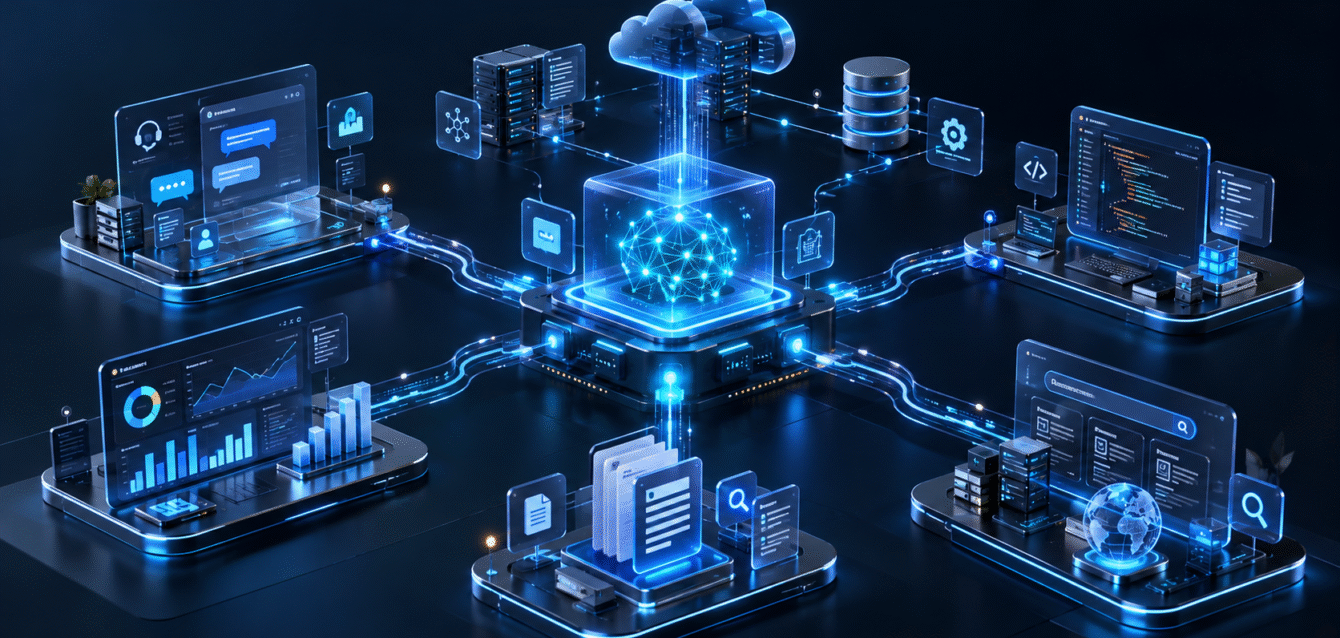
An enterprise AI agent rarely works alone.
A production architecture might combine:
AI Agent + RAG + APIs + Databases + Business Applications
For example, a customer service agent might:
- Receive a customer request
- Retrieve relevant company policies using RAG
- Access customer information through an API
- Determine the appropriate response
- Update the support system
- Escalate the issue when necessary
This is where AI agents become significantly more powerful than standalone chatbots.
The Biggest Challenge: Reliability
Building an AI agent demo can be relatively easy.
Building one that an enterprise can trust is much harder.
Agents need to be evaluated for:
- Accuracy
- Retrieval quality
- Tool usage
- Security
- Cost
- Latency
- Consistency
They also need observability and guardrails so organizations can understand what the agent did and why.
This is why successful enterprise AI is not just about choosing the latest model.
It’s about building the right system around the model.
What’s Next for Enterprise AI?
The future isn’t necessarily one completely autonomous AI replacing entire teams.
Instead, enterprises are likely to build specialized AI agents for specific workflows.
One agent may handle research.
Another may analyze data.
Another may process documents.
These agents can eventually work together to complete more complex business processes.
The shift is from:
AI that answers questions
to
AI that helps execute work.
Final Takeaway
AI agents are becoming an important layer in the enterprise technology stack.
But successful adoption won’t come from simply connecting an LLM to a few APIs.
Enterprises need:
Reliable data + secure tools + strong retrieval + evaluation + human oversight
The real opportunity in 2026 isn’t asking whether AI agents can perform a task.
It’s asking:
Which business workflows can AI agents perform reliably, securely, and at scale?
That’s where the next generation of enterprise AI will be built.achine learning, generative AI, RAG, AI agents, data engineering, and cloud technologies.