




AI models are becoming more capable, but better models alone don’t guarantee better results.
An AI agent can have access to a powerful LLM and still fail because it lacks the right information, retrieves irrelevant documents, forgets previous interactions, or receives too much context at once.
This is where context engineering comes in.
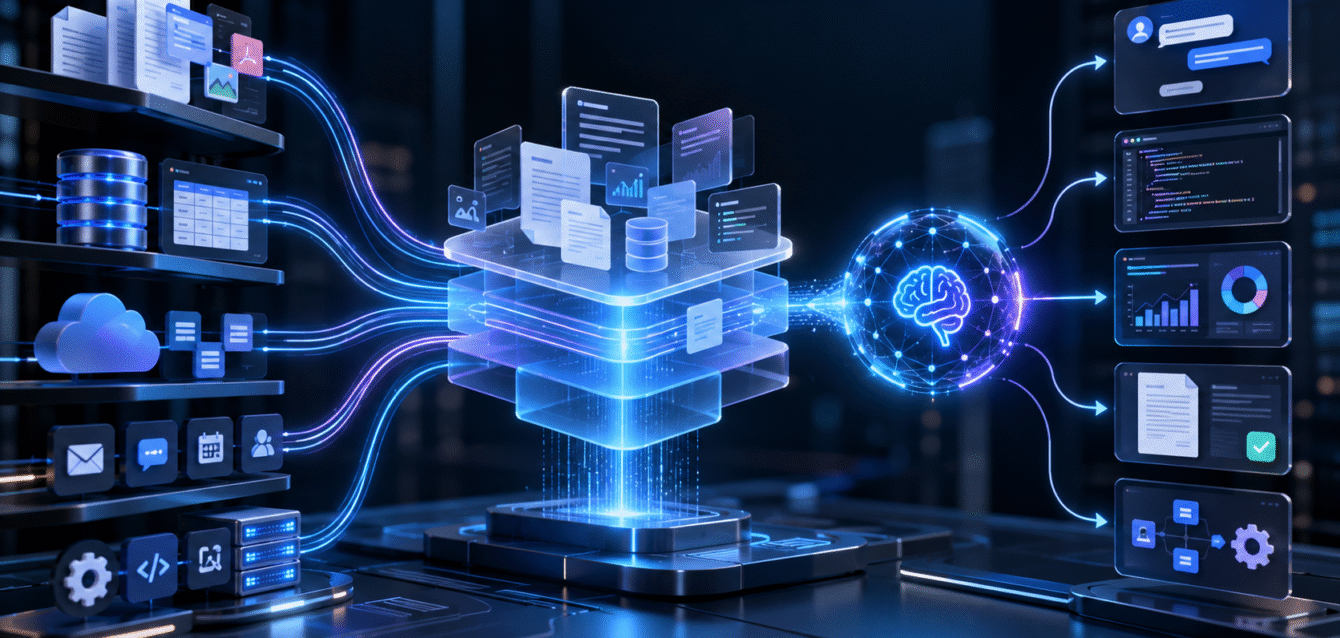
Context engineering is the practice of designing and managing the information an AI system receives at each step, including instructions, conversation history, retrieved knowledge, tool outputs, and relevant business data.
For enterprises building AI agents, it can be the difference between a promising demo and a reliable production system.
What Is Context Engineering?
Prompt engineering focuses on how you instruct an AI model.
Context engineering goes further. It focuses on everything the model needs to know to complete a task effectively.
A useful way to think about it:
Prompt Engineering = What you tell the model
Context Engineering = Everything the model needs to know
This may include system instructions, user history, retrieved documents, database results, available tools, and the current state of a workflow.
Context engineering goes beyond writing better prompts. It involves carefully selecting and managing the information an AI agent receives at each step. Anthropic’s guide to effective context engineering explores this approach in detail.
Why Context Matters for Enterprise AI
Imagine an AI agent helping an employee answer a question about company policy.
The model may be capable of understanding the question, but it still needs access to the correct policy, the employee’s permissions, the latest version of the document, and the relevant conversation history.
Without that context, even a powerful model can produce an inaccurate answer.
Poor context can lead to:
- Incorrect or irrelevant responses
- Hallucinations caused by missing information
- Unnecessary token costs
- Confusion across multi-step workflows
- Inconsistent agent behaviour
The challenge isn’t always the model. Sometimes, it’s the information being provided to it.
The 5 Building Blocks of Context Engineering
1. Retrieval and RAG
Retrieve relevant information from enterprise documents, databases, and knowledge bases instead of overwhelming the model with unnecessary data.
2. Memory Management
Maintain useful information from previous interactions without carrying forward irrelevant conversation history.
3. Context Selection
Prioritise the most relevant instructions, facts, and tool outputs for the current task.
4. Tool and Workflow Context
Give agents access to the appropriate APIs, tools, permissions, and current workflow state.
5. Context Evaluation
Measure whether the information provided is relevant, complete, accurate, and sufficient for the task.
Together, these components help AI systems work with the right information at the right time.
Context Engineering vs RAG
RAG is an important part of context engineering, but the two are not interchangeable.
RAG retrieves relevant information and supplies it to a model.
Context engineering manages the broader information environment in which the model operates.
For example, an enterprise research agent might use RAG to retrieve internal reports, memory to retain the user’s preferences, tool outputs to access live data, and context selection to prioritise the most relevant findings.
RAG supplies knowledge. Context engineering decides what information the AI needs and how to make it useful.
Why Context Engineering Matters for AI Agents
AI agents often operate across multiple steps. They retrieve information, call tools, analyse results, and decide what to do next.
At every step, the agent needs the right context.
Too little context can lead to incorrect decisions. Too much can increase cost, introduce distractions, and reduce the relevance of the model’s response.
Enterprise teams therefore need to design context deliberately, considering security, permissions, freshness, token limits, and task requirements.
This becomes especially important when agents interact with sensitive business data or execute actions across enterprise applications.
How Enterprises Can Get Started
Organisations can begin by identifying where their AI systems lack information or receive irrelevant context.
A practical starting point is to:
- Audit the information supplied to existing AI applications.
- Improve document retrieval and data quality.
- Separate persistent memory from temporary task context.
- Enforce access permissions before retrieving sensitive information.
- Evaluate context quality alongside model accuracy.
- Monitor latency, token usage, and task completion rates.
These improvements can make existing AI systems more reliable without necessarily changing the underlying model.
Final Takeaway
The next stage of enterprise AI won’t be determined by model capability alone.
It will also depend on how effectively organisations manage the information their AI systems receive, retain, retrieve, and act upon.
Better models provide capability. Better context helps turn that capability into useful outcomes.
For businesses moving AI agents into production, context engineering deserves a place alongside RAG, data engineering, evaluation, and security in the enterprise AI stack. agents, data engineering, and cloud technologies.