




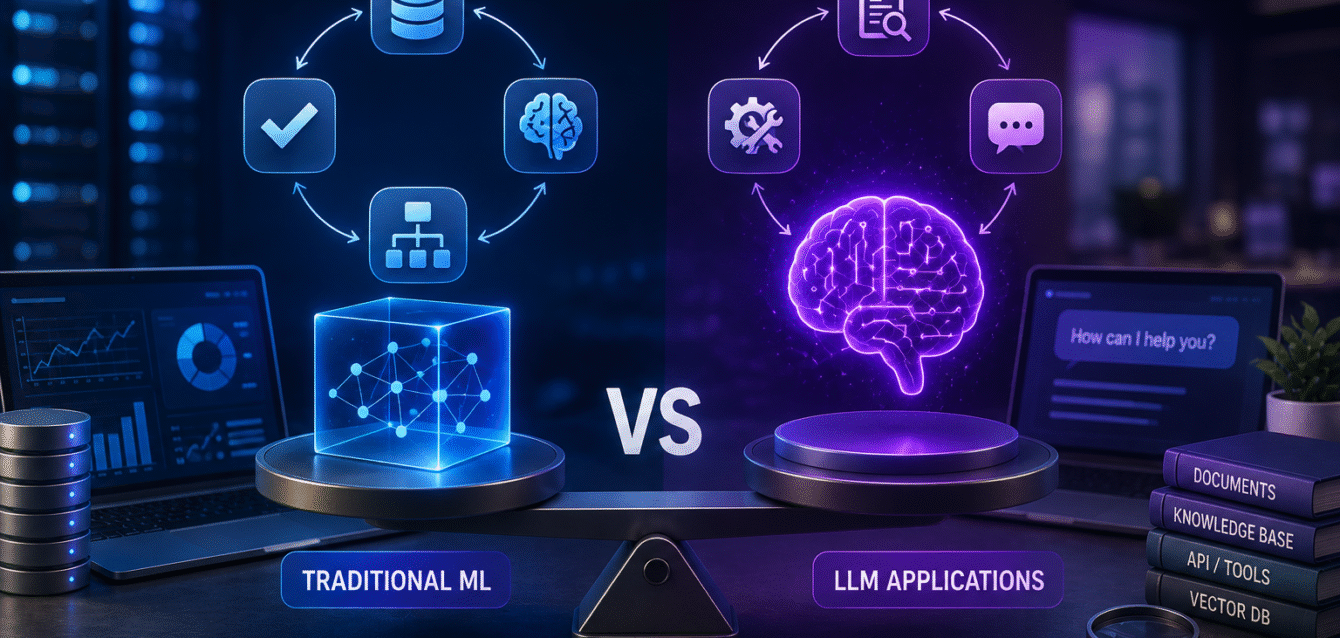
AI is moving from experimentation into real-world applications. As businesses deploy both traditional machine learning models and generative AI, managing these systems in production has become increasingly important.
Two terms you will often hear are MLOps and LLMOps.
Although they share many principles, they address different challenges.
What Is MLOps?
MLOps, or Machine Learning Operations, focuses on managing the lifecycle of traditional machine learning models.
It covers everything from preparing data and training models to deployment, monitoring, and retraining.
A typical MLOps workflow looks like:
Data → Training → Testing → Deployment → Monitoring → Retraining
MLOps is commonly used for applications such as:
- Fraud detection
- Recommendation systems
- Demand forecasting
- Customer churn prediction
- Predictive maintenance
- Image classification
The goal is to make machine learning systems reliable, scalable, and easier to maintain in production.
What Is LLMOps?
LLMOps, or Large Language Model Operations, focuses on applications built using large language models.
Unlike traditional ML, these applications often depend on more than just a trained model.
They may involve:
- Prompts
- RAG
- Vector databases
- Embeddings
- Fine-tuning
- Conversation history
- AI agents
- Guardrails
- Model evaluation
A typical LLMOps workflow might look like:
Data & Knowledge → Prompt / Model → Evaluation → Deployment → Monitoring → Optimization
For example, an enterprise AI assistant may need to retrieve company documents, understand a user’s question, generate an answer, and provide relevant sources.
Managing that entire process falls under LLMOps.
MLOps vs LLMOps
| MLOps | LLMOps |
|---|---|
| Focuses on machine learning models | Focuses on LLM applications |
| Model training is often central | Foundation models are often already trained |
| Uses training datasets | Uses prompts, documents, conversations and knowledge |
| Tracks model performance | Tracks response quality and grounding |
| Model drift is important | Hallucinations and prompt changes are important |
| Traditional ML metrics | LLM evaluation and human feedback |
| Usually focused on predictions | Often focused on generated responses and actions |
| Compute is a major cost | Tokens and inference can be major costs |
Why LLMOps Is Different
The biggest difference is that LLM applications are often systems rather than just models.
A traditional ML application might predict whether a transaction is fraudulent.
An LLM application could receive a question, search a knowledge base, retrieve documents, call a tool, generate a response, and potentially take an action.
This creates additional operational challenges.
Prompt Management
Prompts can directly influence how an LLM behaves. Teams therefore need to test and manage prompt changes.
Retrieval
RAG applications need to retrieve the right information before the model generates a response.
Hallucination
An LLM can generate an answer that sounds convincing but is not supported by the available information.
Cost
LLM applications often have usage-based costs associated with tokens and inference.
Evaluation
It can be harder to evaluate a generated answer than a simple prediction.
Teams may need to measure relevance, accuracy, groundedness, safety, and user feedback.
MLOps and LLMOps Can Work Together
Businesses do not necessarily have to choose between MLOps and LLMOps.
An enterprise AI platform may use both.
For example:
Data Engineering
↓
MLOps for predictive models
↓
LLMOps for generative AI applications
↓
RAG & AI Agents
↓
Cloud Infrastructure
Together, these capabilities provide a foundation for managing different types of AI applications.
When Should You Use MLOps?
MLOps is the better fit when your organization is primarily building traditional machine learning models for prediction or classification.
Think:
“We need to train, deploy, monitor, and retrain a machine learning model.”
When Should You Use LLMOps?
LLMOps becomes important when your application relies on large language models, RAG, generative AI, or AI agents.
Think:
“We need to manage the entire lifecycle of an AI application that generates responses or performs tasks.”
The Future of AI Operations
The line between MLOps and LLMOps will continue to evolve as AI systems become more sophisticated.
Businesses are increasingly combining:
Machine Learning + Generative AI + RAG + AI Agents + Data Engineering
The technology may change, but the objective remains the same:
Build AI systems that are reliable, secure, scalable, and ready for production.
Conclusion
MLOps and LLMOps are closely related, but they focus on different aspects of AI operations.
MLOps manages the lifecycle of machine learning models.
LLMOps manages the lifecycle of applications built around large language models.
For businesses adopting generative AI, understanding LLMOps is becoming just as important as understanding traditional MLOps.
At ImmersiveData.AI, we help businesses build and operationalize AI solutions across machine learning, generative AI, RAG, AI agents, data engineering, and cloud technologies.