




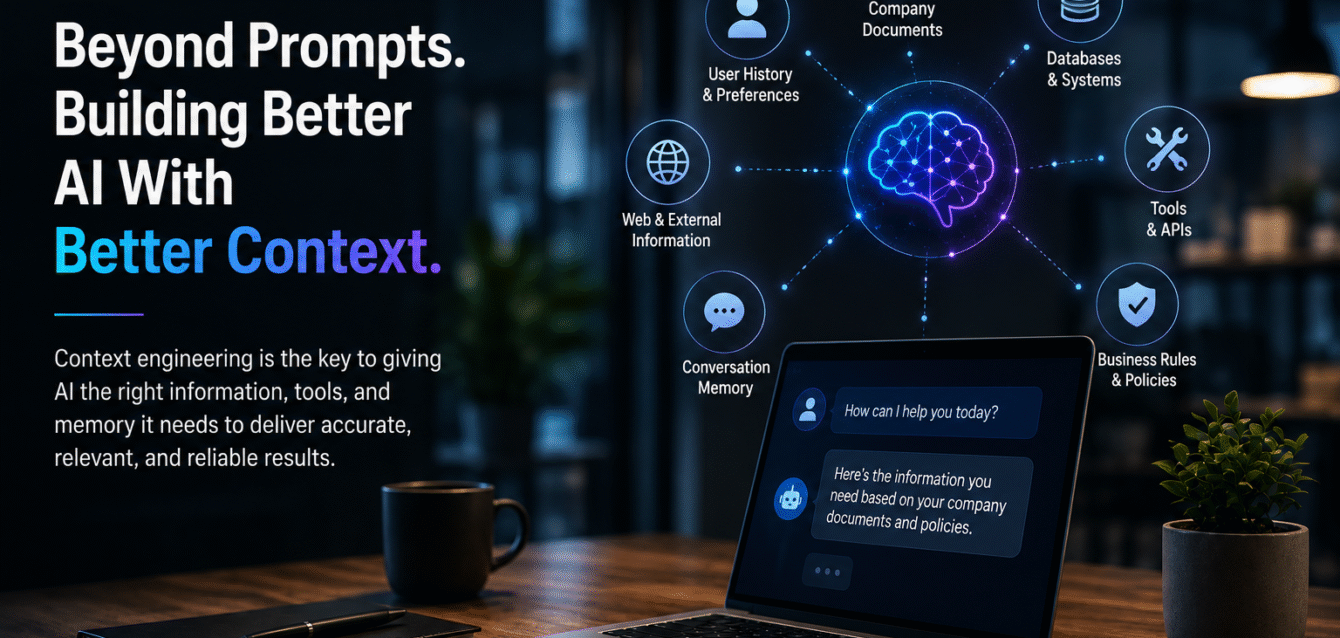
AI has come a long way from simple chatbots. Modern AI systems can access business data, use tools, remember previous interactions, and complete complex tasks. This has created a new challenge: How do you give an AI the right information at the right time?
That’s where context engineering comes in.
What Is Context Engineering?
Prompt engineering focuses on creating effective instructions for an AI model.
Context engineering goes a step further. It focuses on providing the model with the right information, tools, memory, and instructions needed to complete a task.
For example, a customer support AI may need:
- Customer history
- Product information
- Company policies
- Previous conversations
- Relevant documents
- Access to support tools
The goal isn’t to give the AI more information. It’s to give it the right information.
Prompt Engineering vs Context Engineering
| Prompt Engineering | Context Engineering |
|---|---|
| Focuses on instructions | Focuses on the complete information available to AI |
| Mainly improves prompts | Manages data, tools, memory and prompts |
| Often relatively static | Can change dynamically |
| Useful for simple AI interactions | Important for complex AI applications and agents |
Prompt engineering is still valuable. Context engineering simply expands the scope of what developers need to consider.
Why Is Context Engineering Important?
AI models can only make good decisions when they have access to relevant information.
For enterprise applications, that information may come from multiple sources:
Business Data + RAG + Memory + Tools + APIs + Instructions
It brings these pieces together. It can help AI systems:
- Produce more relevant responses
- Use company-specific information
- Avoid unnecessary information
- Make better decisions
- Complete multi-step tasks
This is particularly important for AI agents, which need to continuously gather and use information while completing a task.
How RAG Fits Into Context Engineering
RAG is one of the most important components of context engineering.
A RAG system retrieves relevant information from documents or databases and provides it to the AI model.
For example:
User Question → Search Business Data → Retrieve Relevant Information → AI Generates Response
Context engineering takes this further by deciding what other information the AI needs.
That could include the user’s previous conversation, permissions, business rules, available tools, and the current state of the task.
Context Engineering for AI Agents
AI agents make context even more important.
Imagine an AI sales agent asked:
“Prepare a follow-up for this customer.”
The agent may need to access:
- Customer details
- Previous emails
- CRM records
- Product information
- Pricing
- Company communication guidelines
Providing all of this information at once isn’t necessarily efficient.
A well-designed context system determines what information is relevant at each step.
This allows the agent to work with the information it needs without overwhelming the model with unnecessary context.
The Challenge of Too Much Context
More information doesn’t always mean better AI.
Too much irrelevant context can increase:
- Cost
- Latency
- Complexity
- Conflicting information
- Poor response quality
The objective of context engineering is therefore simple:
Give AI the right context, at the right time, for the right task.
The Future of AI Development
As businesses move from basic chatbots toward RAG applications, AI agents, and intelligent automation, it will become increasingly important.
The AI model is only one part of the system.
The surrounding data, tools, memory, retrieval systems, and business rules can determine how effectively that model performs.
Conclusion
Prompt engineering focuses on what we tell AI.
Context engineering focuses on everything AI needs to know to do the job.
As enterprise AI becomes more capable, building the right context around AI models will be just as important as choosing the model itself.
The future of AI isn’t just better prompts. It’s better context.
At ImmersiveData.ai, we help businesses build intelligent AI solutions using enterprise data, RAG, AI agents, and modern cloud technologies.