



Businesses have more data than ever, but finding the right information at the right time remains a challenge.
Important knowledge is often scattered across PDFs, reports, presentations, databases, knowledge bases, websites, and internal applications. Traditional search can help locate this information, but it does not always understand the context behind a question.
Generative AI changes how businesses can interact with this information.
But there is one important challenge: How do you make an AI model understand your organization’s own data?
This is where Retrieval-Augmented Generation (RAG) comes in.
What Is Enterprise RAG?
Retrieval-Augmented Generation, or RAG, is an approach that connects an AI model to external knowledge sources.
Instead of relying only on what an AI model learned during training, a RAG system retrieves relevant information from a company’s data and provides it to the model as context.
For example, an employee could ask:
“What is our current work-from-home policy?”
Rather than expecting the AI model to already know the answer, the RAG system searches the company’s internal policies, retrieves the relevant information, and uses it to generate a response.
This makes AI more useful for enterprise applications where information is private, specialized, or frequently updated.
How Does Enterprise RAG Work?
A typical RAG workflow looks like:
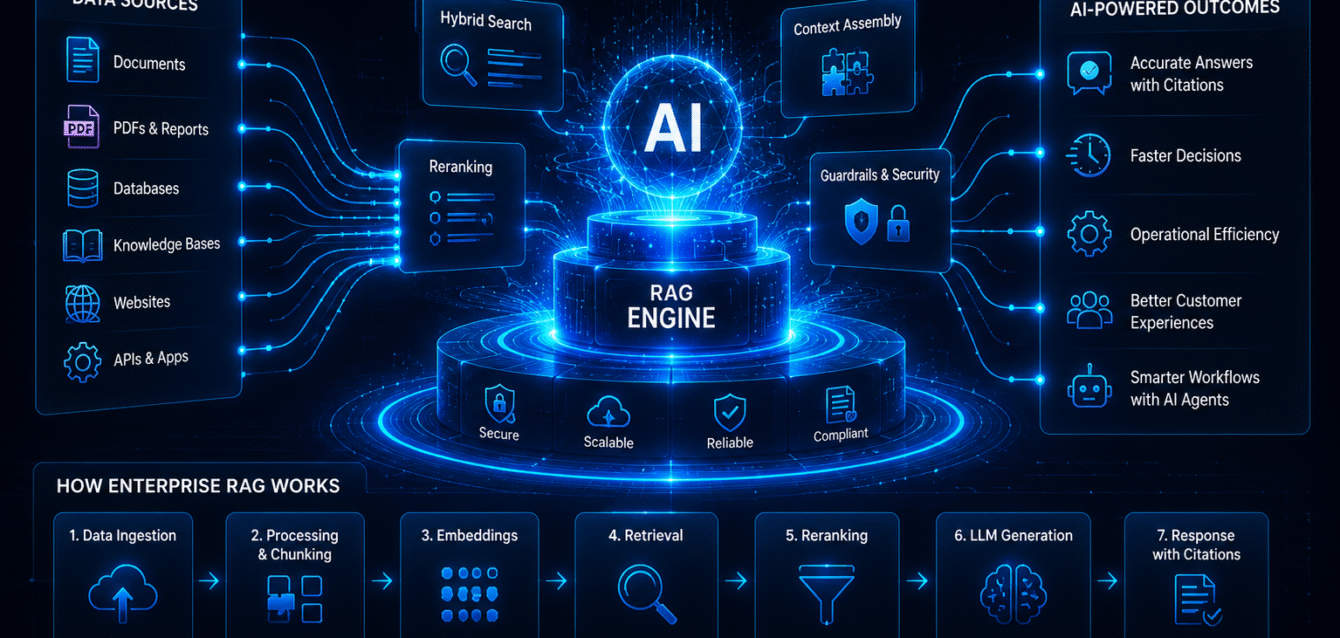
Business Data → Processing → Retrieval → Reranking → LLM → Grounded Response
1. Connect Business Data
The first step is bringing relevant information into the AI system.
This could include:
- PDFs and documents
- Websites
- Databases
- Knowledge bases
- Product documentation
- Customer support data
- Internal policies
- Reports and presentations
Modern enterprise AI platforms increasingly support connecting information across multiple sources rather than keeping knowledge in a single repository.
2. Process and Organize the Data
Enterprise documents are rarely perfectly structured.
A document may contain text, tables, images, headings, or scanned pages.
The system needs to extract and organize this information before it can be effectively retrieved.
Large documents are also divided into smaller sections, or chunks, so that the system can retrieve the specific information relevant to a user’s question.
3. Retrieve Relevant Information
When a user asks a question, the RAG system searches the organization’s knowledge.
Modern systems can combine semantic search and keyword search, often referred to as hybrid search.
This is useful because semantic search can understand meaning, while keyword search can be valuable when exact terms, names, product codes, or policy numbers matter.
4. Rerank the Results
The system may retrieve several potentially relevant results.
A reranking stage can then determine which pieces of information are most relevant to the user’s question.
This helps ensure that the LLM receives better context before generating its answer.
5. Generate a Grounded Answer
Finally, the retrieved information is provided to the LLM.
The model uses this context to generate an answer based on the organization’s data.
A well-designed system can also provide citations or references so users can verify where the answer came from.
Why RAG Matters for Businesses
Access to Private Business Knowledge
General-purpose AI models do not automatically know your company’s latest internal information.
RAG can connect AI applications to private business knowledge without requiring that knowledge to be part of the model’s original training data.
More Up-to-Date Answers
Business information changes constantly.
Policies get updated. Products change. New reports are created.
With RAG, the underlying knowledge source can be updated without retraining the entire language model.
Better Grounding
RAG gives the model relevant information to work with instead of relying entirely on its general knowledge.
This can help reduce unsupported answers and improve factual grounding.
However, RAG is not a guarantee against hallucinations. The quality of the retrieved information and the overall system design still matter.
Better Enterprise Search
RAG can turn traditional search into a conversational experience.
Instead of searching for individual keywords, employees can ask questions in natural language and receive an answer based on information across their organization’s knowledge sources.
RAG vs Fine-Tuning: Which One Should You Choose?
Fine-tuning is generally better when you need to:
RAG is generally better when you need to:
- Connect AI to private business information
- Work with frequently changing data
- Retrieve information from large knowledge bases
- Provide source references
- Keep information outside the model itself
Fine-tuning is generally better when you need to:
- Change a model’s behavior
- Teach a particular response style
- Improve performance on a specialized task
- Produce consistent formats or outputs
For many enterprise knowledge applications, RAG is the more practical starting point because the organization’s information can be updated without retraining the model.
Enterprise RAG Use Cases
RAG can support a wide range of business applications.
Customer Support
Connect AI to product documentation, FAQs, knowledge bases, and support information to help teams respond to customer questions.
Enterprise Document Intelligence
Allow employees to ask questions across large collections of contracts, reports, presentations, policies, and other documents.
Healthcare
Use trusted organizational knowledge and approved information sources to support research, education, documentation, and information retrieval.
Finance
Help teams work with financial reports, policies, research, and regulatory documentation.
Human Resources
Employees can ask questions about benefits, leave policies, onboarding, company guidelines, and internal processes.
Internal Knowledge Management
Give employees a single conversational interface for finding information spread across different systems.
What Makes Enterprise RAG Different?
A basic RAG chatbot can be built relatively quickly.
A production-ready enterprise RAG system is much more complex.
It needs to consider:
- Data quality
- Document processing
- Retrieval accuracy
- Hybrid search
- Reranking
- Security
- User permissions
- Citations
- Monitoring
- Evaluation
- Cost and performance
Security is particularly important.
If an employee does not have permission to access a document, the AI system should not retrieve that information for them.
Enterprise RAG therefore needs to consider not only what information exists, but also who is allowed to access it. Modern enterprise AI platforms are increasingly incorporating permissions-aware retrieval for exactly this reason.
RAG Is Evolving Beyond Document Chatbots
RAG in 2026 is becoming more than simply “chat with your PDFs.”
Modern systems are increasingly combining RAG with:
Hybrid Search
Combining keyword and semantic retrieval.
Multimodal Retrieval
Working with text, images, tables, and other types of information.
AI Agents
Allowing AI systems to retrieve information and then take actions using enterprise tools.
Enterprise Search
Connecting information across multiple business systems.
Continuous Evaluation
Measuring whether retrieved information and generated answers are actually relevant and grounded.
This shift is important because enterprises are moving beyond basic AI assistants toward AI systems and agents that can work across organizational data and complete more complex tasks.
Building a Production-Ready RAG System
A successful enterprise RAG implementation should start with the business problem, not the technology.
Before choosing a vector database or LLM, organizations should ask:
What information does the AI need?
Where does that information currently live?
Who should be able to access it?
How frequently does it change?
How will we measure answer quality?
From there, the architecture can be designed around the organization’s requirements.
A typical implementation may include:
Data Sources → Document Processing → Chunking → Search & Retrieval → Reranking → LLM → Grounded Response → Evaluation & Monitoring
The exact architecture will vary depending on the use case, data volume, security requirements, and cloud environment.
The Future of Enterprise RAG
The future of RAG is not simply about building better chatbots.
It is about giving AI systems reliable access to the information businesses already have.
As AI agents become more capable, RAG can serve as the knowledge layer that allows those agents to understand company policies, retrieve relevant information, interact with enterprise systems, and support business workflows.
The real value comes from combining AI models + business data + reliable retrieval + enterprise security.
Conclusion
Enterprise RAG provides a practical way for organizations to connect generative AI with their own knowledge.
Instead of asking businesses to replace their existing information systems or retrain models every time information changes, RAG allows AI applications to retrieve relevant knowledge when it is needed.
But successful enterprise RAG requires more than connecting a language model to a vector database.
It requires thoughtful data preparation, reliable retrieval, security, evaluation, and a clear understanding of the business problem.
As enterprises move from experimenting with generative AI toward deploying AI in real business workflows, RAG is becoming an important foundation for building AI applications that can understand and work with enterprise data.
At ImmersiveData.ai, we help organizations turn their data into practical AI solutions through data engineering, AI/ML, RAG, intelligent applications, and cloud technologies.