



Artificial Intelligence is rapidly transforming industries across the globe, and cloud computing has become the foundation behind this transformation. As organizations build smarter applications, process massive datasets, and deploy generative AI solutions, scalable infrastructure is more important than ever.
This is where Google Cloud Platform (GCP) plays a major role.
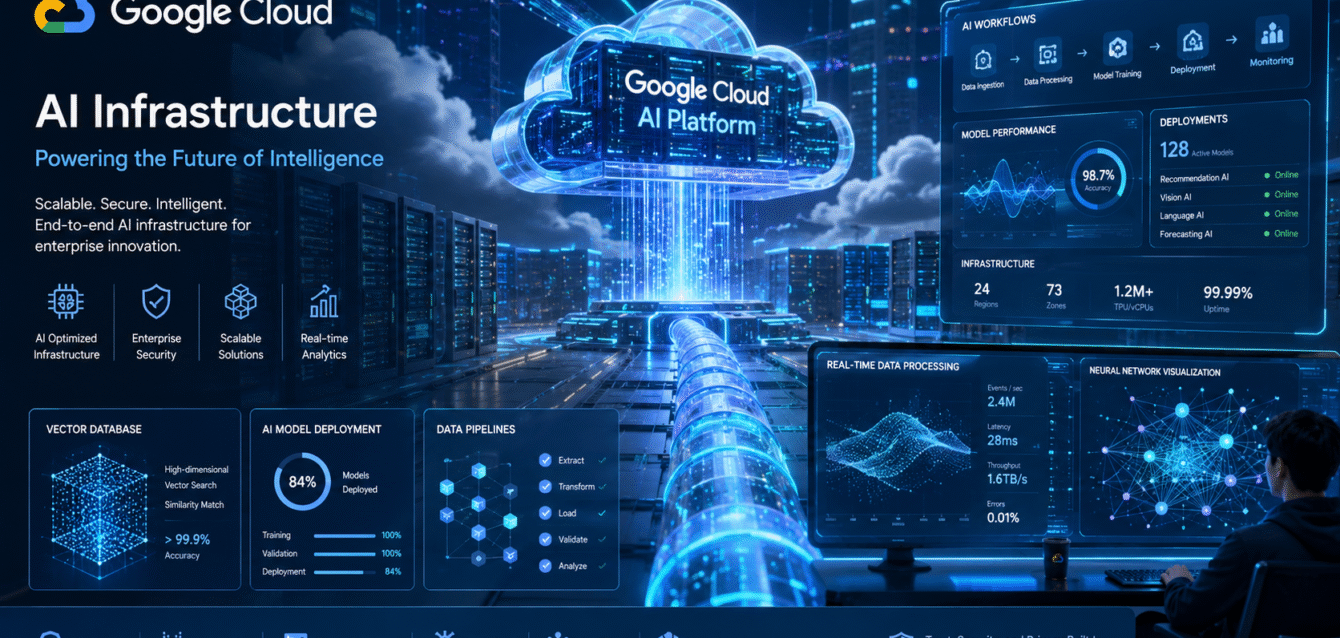
From machine learning and data analytics to generative AI and real-time processing, Google Cloud provides a powerful ecosystem that enables businesses to develop, train, and deploy modern AI applications efficiently.
What is Google Cloud Platform (GCP)?
Google Cloud is a cloud computing platform that offers infrastructure, storage, AI tools, analytics services, and machine learning solutions for businesses and developers.
GCP provides:
- Scalable cloud infrastructure
- GPU and TPU computing
- AI and machine learning services
- Data analytics platforms
- Real-time processing tools
- Enterprise security solutions
Its AI-focused ecosystem makes it one of the leading cloud platforms for modern AI development.
Why Cloud Infrastructure Matters for AI
Modern AI applications require:
- Large-scale data processing
- High-performance computing
- Fast model training
- Scalable deployment
- Real-time analytics
Traditional infrastructure often struggles to handle these workloads efficiently.
Cloud platforms like Google Cloud solve this challenge by providing on-demand computing power, distributed storage, and AI-optimized services.
Key GCP Services Powering AI Applications
1. Vertex AI
Vertex AI is Google Cloud’s unified machine learning platform.
It helps developers:
- Train machine learning models
- Deploy AI applications
- Build generative AI systems
- Manage MLOps workflows
- Scale AI deployments
Vertex AI simplifies the entire AI lifecycle, making it easier for enterprises to build production-ready AI systems.
Why Vertex AI Matters
- Supports foundation models
- Integrated with generative AI tools
- Scalable infrastructure
- Faster model deployment
- Enterprise-ready architecture
2. BigQuery for AI Analytics
BigQuery is Google Cloud’s fully managed data warehouse designed for large-scale analytics.
Modern AI applications rely heavily on data processing, and BigQuery helps organizations:
- Analyze massive datasets
- Run real-time analytics
- Process structured and unstructured data
- Build AI-ready data pipelines
It is widely used for AI-driven business intelligence and predictive analytics.
3. Tensor Processing Units (TPUs)
Google Cloud offers custom-built TPUs specifically optimized for machine learning workloads.
TPUs accelerate:
- Deep learning training
- Large language model inference
- Neural network processing
- AI research workloads
These specialized processors help businesses reduce training time and improve AI performance.
4. Cloud Storage and Data Lakes
AI systems require reliable storage infrastructure.
Google Cloud provides scalable storage solutions for:
- AI training datasets
- Medical imaging
- Video processing
- Real-time streaming data
- Enterprise analytics
Cloud-based data lakes allow organizations to centralize data for AI workflows.
5. Kubernetes Engine (GKE)
Modern AI applications often run in containerized environments.
Google Kubernetes Engine helps businesses:
- Deploy scalable AI systems
- Manage distributed workloads
- Improve infrastructure automation
- Handle microservices architectures
GKE is commonly used for enterprise AI deployment pipelines.
How GCP Supports Generative AI
Generative AI applications require advanced infrastructure capable of handling:
- Massive datasets
- Large-scale inference
- Vector search
- Real-time responses
- AI orchestration
Google Cloud supports generative AI through:
- Vertex AI
- Gemini models
- Vector Search
- AI APIs
- GPU and TPU infrastructure
This allows businesses to build AI assistants, intelligent search systems, recommendation engines, and enterprise copilots.
Real-World AI Use Cases on GCP
Organizations across industries use GCP for:
Healthcare AI
- Medical imaging analysis
- Clinical decision support
- AI-powered documentation
- Predictive healthcare analytics
Retail and E-commerce
- Personalized recommendations
- Customer behavior analysis
- Demand forecasting
Finance
- Fraud detection
- Risk analysis
- Real-time transaction monitoring
Manufacturing
- Predictive maintenance
- Quality control automation
- IoT analytics
Benefits of Using GCP for AI Applications
Scalability
Google Cloud allows organizations to scale AI workloads instantly based on demand.
Faster AI Development
Managed AI services reduce infrastructure complexity and speed up deployment.
Real-Time Processing
GCP supports low-latency analytics and streaming AI applications.
Enterprise Security
Google Cloud includes advanced security features, encryption, and compliance frameworks.
Cost Efficiency
Businesses can optimize computing resources without investing heavily in physical infrastructure.
AI Infrastructure Trends on GCP in 2026
Several trends are shaping the future of AI on Google Cloud:
Multimodal AI
AI systems processing text, images, audio, and video together.
AI Agents
Autonomous AI systems capable of executing complex workflows.
Private Enterprise AI
Organizations building secure internal AI systems.
Vector Databases
Supporting semantic search and retrieval-augmented generation (RAG).
AI-Powered Analytics
Real-time business intelligence powered by machine learning.
Challenges Businesses Face
Despite its advantages, organizations still face challenges such as:
- Managing AI costs
- Ensuring data quality
- Scaling AI systems efficiently
- Governance and compliance
- Infrastructure optimization
A strong cloud architecture strategy is essential for long-term AI success.
Final Thoughts
Google Cloud Platform has become one of the leading ecosystems for modern AI development.
With services like Vertex AI, BigQuery, TPUs, and Kubernetes Engine, businesses can build scalable, intelligent, and real-time AI applications more efficiently than ever before. As a Google Cloud partner, immersivedata.ai helps businesses build scalable AI infrastructure, modern data platforms, and enterprise AI solutions using Google Cloud technologies. From AI analytics and machine learning pipelines to generative AI applications, our team works with organizations to accelerate cloud-native AI transformation.
As AI adoption continues to accelerate in 2026, organizations investing in cloud-native AI infrastructure will gain a significant competitive advantage.
For enterprises exploring generative AI, machine learning, analytics, or intelligent automation, Google Cloud Platform provides the tools and infrastructure needed to power the next generation of AI innovation.