



Businesses have relied on workflow automation for years to eliminate repetitive tasks, reduce manual effort, and improve operational efficiency. From approving invoices and onboarding employees to sending notifications and updating records, traditional workflow automation has become an integral part of digital transformation.
However, modern businesses are increasingly dealing with processes that are dynamic, data-intensive, and require reasoning rather than simply following predefined rules. Customer interactions are less predictable, enterprise data is spread across multiple systems, and business decisions often require contextual understanding.
This is where Agentic AI is transforming enterprise automation.
Unlike traditional workflow automation, Agentic AI systems are designed to understand goals, make decisions, plan actions, use external tools, and adapt to changing situations with minimal human intervention. Instead of executing a fixed sequence of steps, AI agents determine the most appropriate course of action based on the context they receive.
While both technologies aim to improve efficiency, they solve fundamentally different problems. Understanding when to use workflow automation and when to adopt Agentic AI is essential for building scalable, intelligent, and cost-effective business solutions.
What Is Workflow Automation?
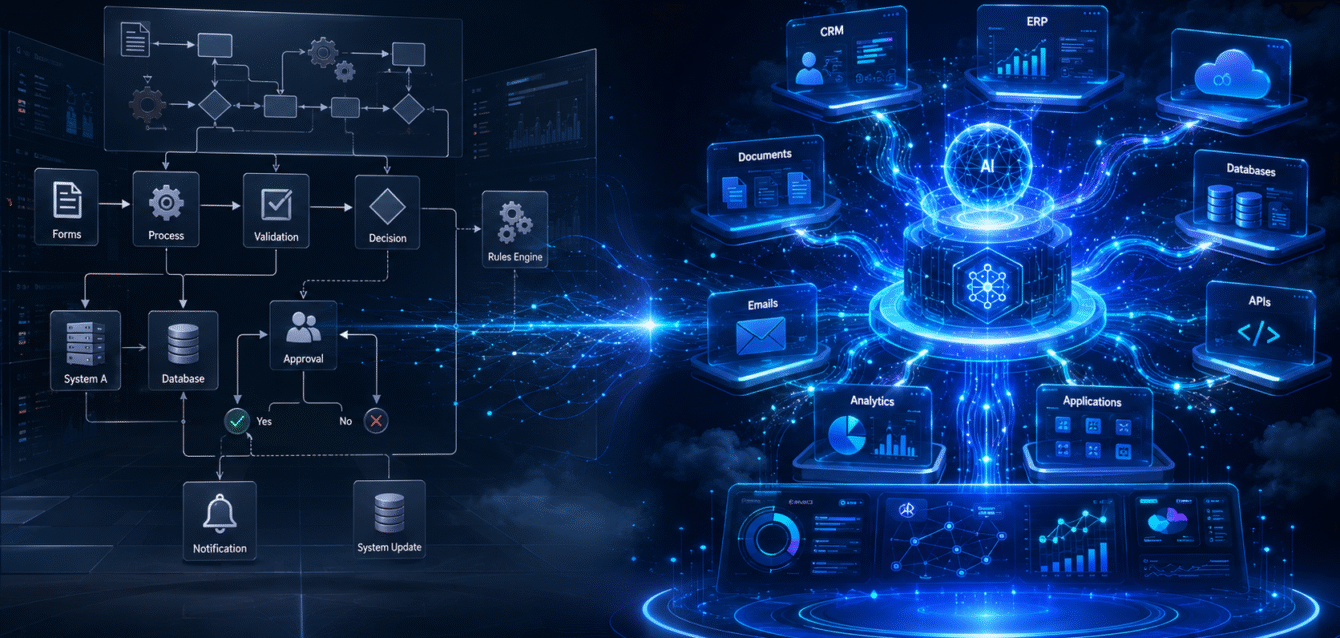
Workflow automation is the process of automating repetitive business tasks using predefined rules and conditions. Every step in the workflow follows a fixed sequence, making it ideal for structured and predictable business operations.
For example, when an employee submits a leave request, the workflow automatically routes it to the reporting manager for approval, then updates the HR system, and finally notifies the employee of the outcome. Since every request follows the same predefined path, no decision-making or reasoning is required.
Workflow automation is commonly used for:
- Invoice approvals
- Employee onboarding
- Purchase order processing
- Email notifications
- Data synchronization
- Customer onboarding
- Document approvals
Because these processes follow clearly defined business rules, workflow automation provides speed, consistency, and reliability.
What Is Agentic AI?
Agentic AI represents the next generation of enterprise automation.
Instead of following predefined instructions, an AI agent is given an objective. It independently determines how to achieve that objective by reasoning through available information, selecting appropriate tools, planning multiple actions, and adapting when circumstances change.
An AI agent can:
- Understand user intent
- Break complex objectives into smaller tasks
- Retrieve information from multiple systems
- Analyze structured and unstructured data
- Interact with APIs and enterprise applications
- Collaborate with other AI agents
- Escalate decisions to humans when necessary
- Learn from feedback to improve future performance
Rather than automating tasks, Agentic AI automates decision-making processes.
Workflow Automation vs Agentic AI
| Feature | Workflow Automation | Agentic AI |
|---|---|---|
| Decision Making | Rule-based | Context-aware |
| Adaptability | Low | High |
| Handles Unstructured Data | Limited | Excellent |
| Dynamic Planning | No | Yes |
| Tool Selection | Fixed | Intelligent |
| Multi-Step Reasoning | No | Yes |
| Human Collaboration | Limited | Built-in |
| Best For | Repetitive processes | Complex business workflows |
When Workflow Automation Is the Better Choice
Workflow automation remains the most efficient solution for processes that are predictable and governed by well-defined business rules.
Employee Leave Management
Every leave request follows the same approval chain:
Employee → Manager → HR → Payroll
The workflow does not require interpretation or reasoning, making traditional automation the ideal choice.
Invoice Processing
When payment is confirmed, the workflow can automatically:
- Generate an invoice
- Send it to the customer
- Update the accounting system
- Notify relevant departments
These steps rarely change and can be executed consistently through workflow automation.
Password Reset Requests
Identity verification, password reset, and notification emails all follow standardized procedures that do not require intelligent decision-making.
When Agentic AI Is the Better Choice
Agentic AI becomes valuable when processes involve uncertainty, multiple decision paths, or unstructured information.
Customer Support
Traditional chatbots often rely on predefined responses. AI agents, however, can:
- Understand customer intent
- Retrieve account information
- Search internal documentation
- Analyze previous support tickets
- Recommend personalized solutions
- Escalate only when necessary
This results in faster resolutions and improved customer satisfaction.
Loan Processing
Evaluating a loan application often involves analyzing multiple sources of information.
An AI agent can:
- Review submitted documents
- Validate applicant information
- Assess financial history
- Analyze risk indicators
- Cross-check internal policies
- Prepare recommendations for loan officers
Rather than replacing human decision-makers, AI agents provide intelligent assistance that improves speed and consistency.
Healthcare Documentation
Healthcare professionals spend significant time documenting patient interactions.
An AI agent can:
- Convert conversations into structured clinical notes
- Identify diagnoses and symptoms
- Suggest medical codes
- Generate discharge summaries
- Create follow-up tasks
- Update electronic health records
Each consultation is unique, making adaptive reasoning far more valuable than fixed workflows.
Enterprise Knowledge Management
Employees often spend hours searching across multiple systems for information.
An AI agent can:
- Search knowledge bases
- Retrieve relevant documents
- Compare information from different sources
- Summarize findings
- Generate reports with references
Instead of simply locating documents, the agent delivers meaningful insights.
Key Questions to Help You Decide
Before implementing automation, consider the following questions.
Choose Workflow Automation if:
- The process follows predefined business rules.
- Every decision path is predictable.
- Inputs are structured and standardized.
- Compliance requires deterministic execution.
- Exceptions occur infrequently.
- Speed and consistency are the primary objectives.
Choose Agentic AI if:
- The process requires reasoning and judgment.
- Business rules change frequently.
- Data comes from multiple systems.
- Users ask open-ended questions.
- The workflow includes multiple possible outcomes.
- Human collaboration is required during decision-making.
Can Workflow Automation and Agentic AI Work Together?
In fact, the most successful enterprise automation strategies combine both technologies.
Workflow automation provides governance, compliance, and process orchestration, while Agentic AI handles complex reasoning and decision-making within those workflows.
For example:
A customer submits a service request. The workflow automatically creates a support ticket and assigns it to an AI agent. The AI agent analyzes the issue, retrieves relevant customer information, searches internal documentation, suggests a solution, and determines whether human intervention is required.
Once the issue is resolved, the workflow updates the CRM, notifies the customer, and closes the ticket. This hybrid approach combines the reliability of workflow automation with the intelligence of AI agents.
Industry Applications
Healthcare
Workflow Automation
- Appointment reminders
- Billing workflows
- Prescription renewals
- Insurance claim submissions
Agentic AI
- Clinical documentation
- Medical coding assistance
- Patient support
- Care coordination
- Treatment summarization
Banking and Financial Services
Workflow Automation
- Account opening
- EMI reminders
- KYC verification
- Payment processing
Agentic AI
- Loan underwriting assistance
- Fraud investigation
- Financial advisory
- Customer query resolution
- Credit risk analysis
Manufacturing
Workflow Automation
- Inventory updates
- Purchase approvals
- Maintenance scheduling
Agentic AI
- Predictive maintenance
- Root cause analysis
- Supply chain optimization
- Production planning
Human Resources
Workflow Automation
- Leave approvals
- Payroll processing
- Employee onboarding
Agentic AI
- Resume screening
- Candidate matching
- Interview scheduling
- Employee assistance
- Learning recommendations
Challenges of Implementing Agentic AI
While Agentic AI offers significant advantages, organizations should also consider several implementation challenges.
Governance
AI agents must operate within clearly defined business policies and compliance requirements.
Security
Since AI agents often interact with enterprise systems and sensitive data, strong access controls and authentication mechanisms are essential.
Explainability
Organizations need visibility into how AI agents arrive at decisions, particularly in regulated industries.
Human Oversight
High-risk decisions should always include human review to ensure accountability and compliance.
Monitoring
Like any enterprise application, AI agents require continuous monitoring to evaluate performance, accuracy, and reliability over time.
The Future of Enterprise Automation
Enterprise automation is evolving beyond simple rule-based workflows.
Organizations are increasingly adopting intelligent systems that combine structured automation with autonomous AI capabilities. Rather than replacing workflow automation, Agentic AI enhances it by introducing reasoning, adaptability, and contextual decision-making.
Businesses that successfully integrate these technologies will be able to automate more complex processes, improve operational efficiency, reduce manual workloads, and deliver better customer experiences.
Final Thoughts
Workflow automation and Agentic AI are not competing technologies. They solve different challenges and are most effective when used together.
If your business processes are predictable, repetitive, and rule-based, workflow automation remains the fastest and most cost-effective solution.
If your processes involve complex decision-making, multiple data sources, changing conditions, or human-like reasoning, Agentic AI offers capabilities that traditional automation cannot provide.
As organizations continue their digital transformation journey, the future belongs to hybrid automation strategies where workflow engines provide structure and governance, while AI agents bring intelligence, adaptability, and autonomous decision-making to enterprise operations.
By choosing the right technology for the right problem, businesses can build automation solutions that are not only efficient but also resilient, scalable, and ready for the future.